Infinite linear elastic plate with hole
Problem description
We consider the case of an infinite plate with a circular hole with radius in the center. The plate is subjected to uniform tensile load at infinity. The analytical solution for the stress field has been derived by Kirsch in 1898 1.
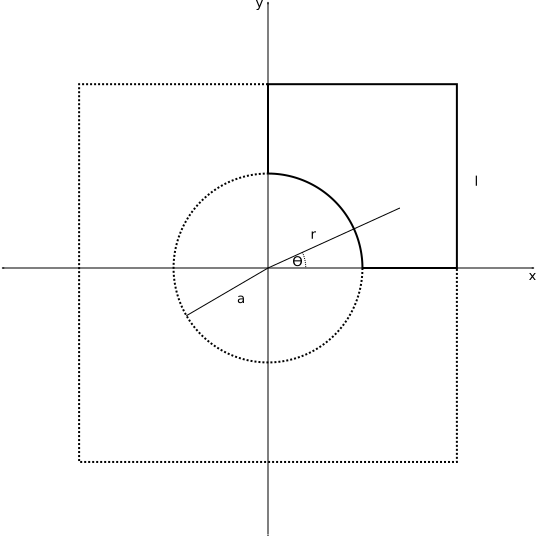
The solution is given in polar stress components of the Cauchy stress tensor at a point with polar coordinates . Assume that the infinite plate is loaded in -direction with load , then the polar stress components are given by
In order to write the stresses in a cartesian coordiante system, they need to be rotated by , which results in
with the full stress tensor solution given by
or for a cartesion point :
In order to transform this into a practical benchmark, we consider a rectangular subdomain of the infinite plate around the hole. The boundary conditions of the subdomain are determined from the analytical solution. The example is further reduced by only simulating one quarter of the rectangular domain with length and assuming symmetry conditions at the edges. Let
be the domain of the benchmark example and
then the PDE with the displacement as solution variable is given by
with the material parameters -- the Youngs modulus and Poisson ratio. The traction is the Cauchy stress tensor multiplied by the normal vector on the boundary . Prescribing a value on a subset of the boundary is referred to as a Neumann boundary condition in computational mechanics. In this specific example,
Weak formulation and numerical solution
In the weak formulation of the problem, we want to find such that
with a test function and
In order to solve the weak formulation, the finite-element method (FEM) can be used. This method discretizes the domain into so called finite elements that can for example be triangles or quadrilaterals in 2D. On these elements, ansatz functions are defined such that they are continuous on the boundaries between elements. These functions form a basis for the solution space for an approximate solution of the problem.
Output metrics
-
The approximate solution is compared with the analytical solution using the norm which is defined as
This norm is computed for the error between the finite element solution and the analytical solution of displacements i.e., .
-
The maximum displacement error is computed at the nodes of the finite element mesh with respect to the analytical solution.
where denotes the set of nodes of the finite element mesh.
-
Max Von-Mises stress
-
Displacement at the top-right corner of the plate.
-
The reaction force at the left boundary.
-
The number of Degrees of Freedom in the finite element mesh.
Table of parameters
Model parameters
| Parameter | Description |
|---|---|
| [m] | Radius of the hole. |
| [m] | Length of the benchmark domain. |
| [Pa] | Youngs modulus. |
| [-] | Poisson ratio. |
| [Pa] | Load at infinity. |
Numerical parameters
| Parameter | Description |
|---|---|
| [m] | Element size. |
| [-] | Element order, i.e. the geometry interpolation order (curved edges or linear edges). |
| [-] | Degree of the ansatz functions. |
| [-] | Degree of the quadrature rule, meaning the polynomial degree which is still integrated exactly. |
| [-] | Quadrature rule (e.g. Gauss or Gauss-Lobatto). |
Numerical Results
FEniCS

Kratos
-
Ernst Gustav Kirsch. Die theorie der elastizität und die bedürfnisse der festigkeitslehre. Zeitschrift des Vereines deutscher Ingenieure, 42:797–807, 1898. ↩